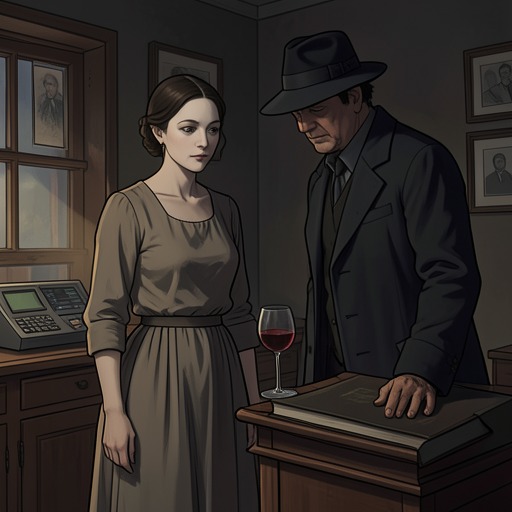
Anselmo and Lotario’s friendship, betrayed through their affair and deception
Don QuixoteAnselmo and Lotario’s friendship, betrayed through their affair and deception, is the central bond in the embedded tale of Anselmo’s ill-advised experiment. Anselmo’s confidence in Lotario leads him to invite his friend to court Camilla as a test of her fidelity. But the experiment does not preserve the boundary between performance and reality: Lotario and Camilla become involved, and the friend entrusted with testing the marriage becomes one of the people concealing its breach. Their changing relationship is measured by a widening gap between what Anselmo believes and what his friend knows.
Friendship Put to the Test
Anselmo initially treats Lotario as a trusted confidant. He gives him permission to make advances to Camilla, expecting the exercise to demonstrate her virtue; Lotario’s conduct is thus bound up with a confidence Anselmo places in their friendship. When Lotario later tells him that Camilla has supposedly yielded, Anselmo is astonished. He had believed she had resisted the advances and was beginning to take satisfaction in what he considered her victory.
Even after hearing the accusation, Anselmo responds by reaffirming his faith in Lotario. He accepts his friend’s account and agrees to follow his advice: he is to pretend to leave for two or three days, hide in a closet, and observe Camilla without her knowledge. Lotario frames this plan as a way for Anselmo to see the truth for himself. The advice sounds like assistance from a loyal friend, but it makes Anselmo an unwitting observer in a scheme whose real circumstances Lotario understands better than he does.
Jealousy and a False Confession
Lotario’s accusation arises after he sees a man leaving Anselmo’s house at daybreak, his face concealed. He assumes the stranger is Camilla’s lover, although the man is Leonela’s. Instead of pausing to consider that possibility, Lotario becomes jealous and rushes to Anselmo before he has risen. He falsely presents Camilla as having promised him a private meeting, while also urging Anselmo not to punish her before seeing what happens.
This is a reversal of the role Anselmo assigned him. Lotario had been asked to approach Camilla so that Anselmo could test her; now he uses the test’s secret arrangements to make Anselmo suspect her. The accusation is especially damaging because it combines a false report with a plan for apparent verification. Anselmo is not simply told to distrust his wife: he is persuaded that he can observe her himself, without knowing that the evidence he expects to interpret has been shaped by the people he is watching.
After telling Anselmo what he has said, Lotario recognizes that he has acted rashly and regrets the harm he may have done. He decides to confess his mistake to Camilla. When she explains that the man leaving the house was Leonela’s lover, and describes how her own secret involvement with Lotario has left her unable to reprimand her servant without exposing herself, Lotario becomes convinced that she is telling the truth. His jealousy gives way to confusion and remorse. He tells Camilla about the plan to hide Anselmo in the closet and asks how they can escape the predicament his impulsive disclosure has created.
The Performance Anselmo Misreads
Camilla sees that Anselmo’s concealment can be turned to their advantage. She instructs Lotario to go along with the arrangement, and to respond to her as though he did not know Anselmo was listening. The result is a performance Anselmo takes for an unguarded demonstration of Camilla’s fidelity. The narration presents it as convincing enough that he believes he has witnessed the destruction of his suspicions rather than a scene contrived to manage them.
When the opportunity comes, Anselmo leaves the house and goes straight to Lotario, eager to share his happiness. He embraces his friend, praises Camilla, and credits Lotario’s judgment and skill with helping establish her purity. Lotario cannot share his delight: he remembers that Anselmo has been deceived and that he himself has wronged his friend. Yet Anselmo reads Lotario’s restrained response as concern about Camilla’s supposed injury, not as remorse over the deception. He reassures Lotario that the wound is slight and urges him to rejoice with him. Anselmo’s trust remains intact precisely because he misinterprets the sign that might have unsettled it.
Betrayal and Consequence
The arrangement continues for a time. Anselmo, convinced that Lotario has helped secure his honor, leads home by the hand the man who has helped destroy it. Camilla receives Lotario with an outwardly averted countenance, while the narrator makes clear that appearances conceal a different response. Each part of this reunion sharpens the story’s central irony: Anselmo believes he is honoring a faithful friend and a faithful wife, while Lotario knows the belief rests on deception.
After several months, the concealed guilt becomes public, and Anselmo pays with his life for his ill-advised curiosity. The friendship’s collapse is therefore more than Lotario’s individual betrayal. Anselmo’s decision to turn trust into an experiment makes the bond serve as an instrument of surveillance, while Lotario’s jealousy and false confession deepen the damage. Their relationship gives the embedded tale its tragic structure: the friend whose word Anselmo trusts helps him mistake a staged appearance for truth, and the recognition of what that trust concealed comes only after the deception can no longer be contained.